
OPENPichia strains
OPENPichia strains
The OPENPichia platform is a growing resource that consists of multiple Pichia strains, which are derivatives of the NCYC 2543 type strain. This type strain is a valid equivalent deposit to the UC Davis type strain of K. phaffii (UCD-FST K-239) deposited by the discovery of what was then named Pichia pastoris and later reclassified as Komagataella phaffii1. Comparative strain genome sequencing in several labs2,3 has revealed that the patent-deposited strain NRRL Y-11430 (CBS 7435) from which most industrially-used Pichia strains are derived, is genetically closest and almost identical to this particular type strain. As the industrial parental strain is still not freely available and encumbered with restrictive MTA's and royalty-bearing licensing conditions, we de novo engineered the key mutation (HOC1 truncation) that enables high transformation efficiency and may in some cases aid in protein secretion and lower clumping behavior. We renamed the HOC1-truncated derivative of the NCYC 2543 type strain, OPENPichia. OPENPichia strains are killer-type plasmid free. All derivatives have been generated using free-to-operate split-marker technology4.
With the OPENPichia initiative an alternative is made available to the public for a nominal one-time fee, allowing research, distribution and commercial manufacturing with any OPENPichia derivative. Details are specified in the accompanying MTA, which can be requested via the contact page.
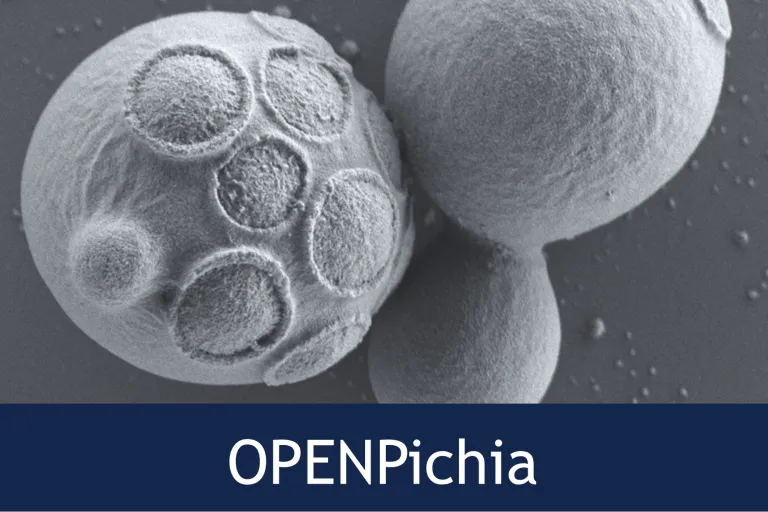
OPENPichia (NCYC 2543 hoc1tr)
NGS revealed a single nucleotide polymorphism in the HOC1 gene, encoding an α-1,6-mannosyl-transferase, between NRRL Y-11430 and the NCYC 2543 type strain. Introduction of this mutation in NCYC 2543 using the free-to-use split-marker cassette technology, resulted in a strong increase in transformation efficiency of the strain, up to the level and even outperforming NRRL Y-11430. On all other investigated aspects, i.e. growth characteristics, cell wall composition, recombinant protein production, host cell proteins, the strain behaves equivalently to NRRL Y-11430. We therefore propose this hoc1-truncated strain, OPENPichia, as the new 'open source' chassis strain that can be used by the broad Pichia community.
OPENPichia his4
To enable antibiotic-free selection, histidine auxotrophy is introduced in the highly transformation-competent OPENPichia background using the free-to-use split-marker cassette technology (Δaa102-aa719) .
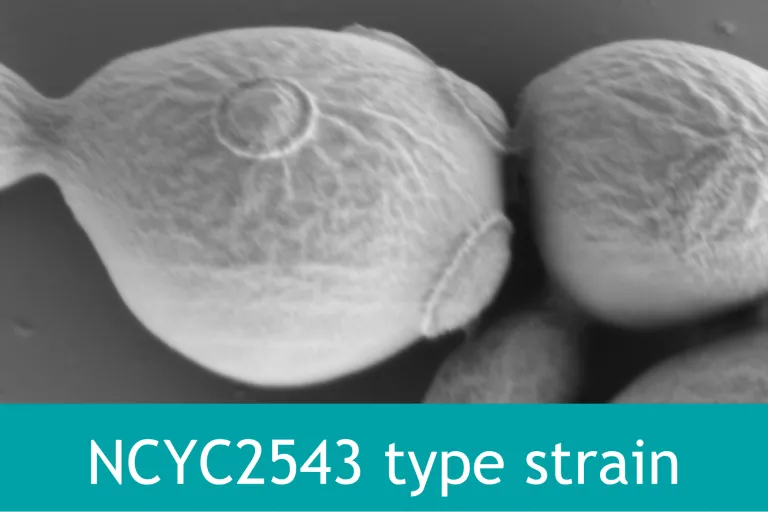
NCYC 2543 type strain
Th type strain shows a substantially lower transformation efficiency as compared to strains with a hoc1 truncation, such as OPENPichia or NRRL Y-11430. The type strain deposit can also be acquired directly from the NCYC culture collection with the option to obtain a distribution or commercial license.
OPENPichia pep4
This strain contains a large deletion (Δaa80-aa307) in one of Pichia's main secreted proteases, i.e. pep4p. Pep4p is responsible for the degradation of a substantial number of recombinantly produced proteins.
OPENPichia yps1
This strain contains a large deletion (Δaa80-aa513) in one of Pichia's main secreted proteases, i.e. yps1p. Yps1p is responsible for the degradation of a substantial number of recombinantly produced proteins.
OPENPichia pep4 yps1
This strain contains large deletions in two of Pichia's main secreted proteases, i.e. pep4p (Δaa80-aa307) and yps1p (Δaa80-aa513). Pep4p and yps1p are responsible for the degradation of a substantial number of recombinantly produced proteins.
OPENPichia mutS
This strain contains a deletion in Pichia's AOX1 gene (Δnt-65-nt1634) , resulting in the methanol utilization slow phenotype.
OPENPichia mutS pep4 yps1
This strain contains one deletion in Pichia's AOX1 gene (Δnt-65-nt1634) resulting in the methanol utilization slow phenotype, combined with large deletions in two of Pichia's main secreted proteases, i.e. pep4p (Δaa80-aa307) and yps1p (Δaa80-aa513). Pep4p and yps1p are responsible for the degradation of a substantial number of recombinantly produced proteins.
Suggestions for further relevant derivatives are welcome; as are contributions to the platform!
Claes K, Van Herpe D, Vanluchene R, Roels C, Van Moer B, Wyseure E, Vandewalle K, Eeckhaut H, Yilmaz S, Vanmarcke S, Çıtak E, Fijalkowska D, Grootaert H, Lonigro C, Meuris L, Michielsen G, Naessens J, van Schie L, De Rycke R, De Bruyne M, Borghgraef P, and Callewaert N. OPENPichia: licence-free Komagataella phaffii chassis strains and toolkit for protein expression. Nat microb (2024) doi: 10.1038/s41564-023-01574-w
https://www.nature.com/articles/s41564-023-01574-w
OPENPichia® is a registered trademark of VIB vzw.
1 Kurtzman, C. P. Description of Komagataella phaffii sp. nov. and the transfer of Pichia pseudopastoris to the methylotrophic yeast genus Komagataella. Int. J. Syst. Evol. 55, 973–976 (2005).
2 Brady, J. R. et al. Comparative genome‐scale analysis of Pichia pastoris variants informs selection of an optimal base strain. Biotechnology and Bioengineering 117, 543–555 (2020).
3 OPENPichia: building a free-to-operate Komagataella phaffii protein expression toolkit | bioRxiv. https://www.biorxiv.org/content/10.1101/2022.12.13.519130v1.
4 Heiss, S., Maurer, M., Hahn, R., Mattanovich, D. & Gasser, B. Identification and deletion of the major secreted protein of Pichia pastoris. Appl Microbiol Biotechnol 97, 1241–1249 (2013).